
Part of Photo to Cross Stitch Pattern, Step by Step
How Many Colours in a Cross Stitch Pattern?
For a photo of a pet or a person, 15 to 20 thread colours is a good start. Simple illustrations need about 10 to 20, and a flat drawing needs a few more colours than it has paint, not exactly the same number.
We charted three very different pictures at 80 stitches wide and six colour settings, and measured what each extra colour bought. Every number below is real output from Photostitch.
What changes when you add colours?
More colours make the chart closer to the picture, but each one gets less noticeable, while the scattered single stitches keep growing. On the cat photo, going from 6 to 15 colours gave most of the improvement; going from 15 to 40 closed much less and more than doubled the single stitches.
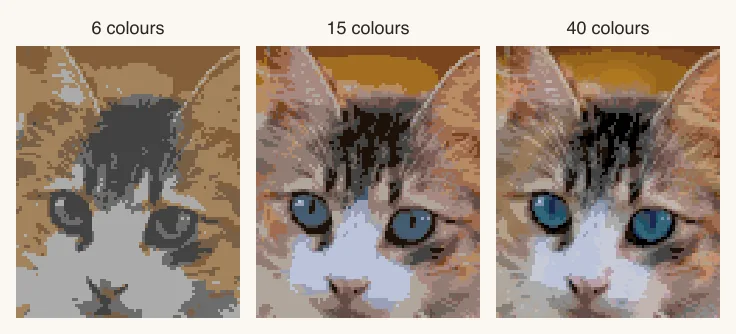
We measured closeness as the average colour difference between the photo under each stitch and the thread chosen for it, using the CIEDE2000 colour difference formula. Lower is closer, and a difference of about 1 is roughly the smallest most people can see side by side.
| Colours asked for | Cat photo | Cottage illustration | Flat heart drawing |
|---|---|---|---|
| 6 | 8.9 · 88 confetti | 7.7 · 63 confetti | 2.5 · 27 confetti |
| 10 | 7.2 · 199 confetti | 5.8 · 106 confetti | 2.1 · 58 confetti |
| 15 | 5.9 · 267 confetti | 5.3 · 160 confetti | 2.0 · 117 confetti |
| 20 | 5.6 · 321 confetti | 4.9 · 172 confetti | 2.0 · 148 confetti |
| 30 | 5.0 · 470 confetti | 4.7 · 216 confetti | 1.9 · 207 confetti |
| 40 | 4.7 · 637 confetti | 4.3 · 254 confetti | 1.9 · 233 confetti |
Confetti stitches are single stitches with no neighbour of the same colour. Each one means starting and finishing a thread, so they are the slow, fiddly part of a chart.
How many colours does a photo need?
Start at 15 to 20 colours for a pet or portrait photo. On the cat, the colour difference fell from 8.9 at 6 colours to 5.9 at 15, and only to 4.7 at 40.
Those last gains cost a lot of stitching. Confetti rose from 267 at 15 colours to 321 at 20 and 637 at 40, mostly in the fur.
Fur, skin and soft backgrounds blend gradually, so a photo uses every colour you give it. At 40 colours only 3 of the cat's threads were used fewer than 50 times.
How many colours does an illustration need?
About 10 to 20 for a drawing with shading, such as our cottage sample. Its colour difference was 5.8 at 10 colours, 4.9 at 20 and 4.3 at 40.
Past 20, the extra colours mostly became threads you would barely use. At 40 colours, 20 of the 40 threads covered fewer than 50 stitches each, and every one of them is a skein to buy.
Why not use exactly the colours in a flat drawing?
Because the soft edges between shapes are colours too, and they can crowd out a small shape. Our heart drawing has 5 flat colours, but asking for 5 lost the sun and both leaves.
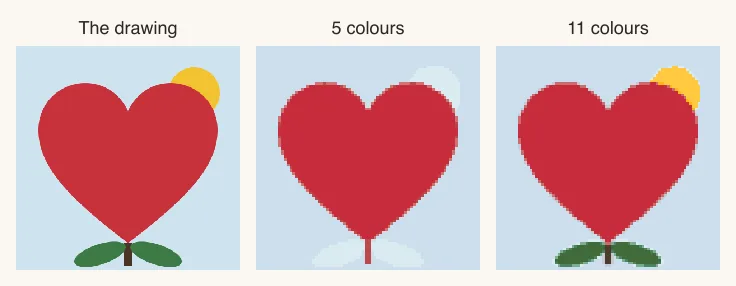
The tool splits the group of colours with the most variation first. The big sky and heart, with their blended edges, used up all 5 places before the small sun and leaves got one.
Asking for 12 gave 11 threads, and every shape had its own, down to the stem at 14 stitches of DMC 3031. Going further did little: at 40 colours, 35 of the 39 threads were edge shades under 50 stitches each.
How do I pick the number for my own picture?
Start near 20 and look at the thread key. If several threads have only a handful of stitches, turn the colours down; if something important, like the eyes, has turned grey or vanished, turn them up.
- Pet or portrait photo: start at 15 to 20.
- Illustration with shading: start at 10 to 20.
- Flat drawing, logo or cartoon: start at about twice its paint colours, then lower it, stopping before a shape disappears.
The Colours slider in our cross stitch pattern maker redraws the chart as you move it, so you can compare settings in a few seconds. Each colour is a skein to buy, so it is worth reading how much floss you need before you choose.
Photo: Tabby cat with blue eyes by AdinaVoicu, released under the CC0 1.0 Universal Public Domain Dedication. We cropped it and charted it with Photostitch.

Chart your own photo
Next: read the full guide, Photo to Cross Stitch Pattern, Step by Step.